

In the demanding landscape of automotive parts mold machining, precision and repeatability define success. Manufacturing large, complex molds challenges even the most advanced machine tools due to geometric deviations, thermal distortions, and process variability. This article explores how geometric accuracy compensation technology, synergized with five critical process techniques, drives consistent mold quality—empowering B2B suppliers to meet rigorous automotive standards reliably.
Automotive molds demand tolerances often within ±5 microns, yet several factors compromise this target:
To address these challenges, integrating the following methods enhances machining accuracy significantly:
Geometric accuracy compensation is a sophisticated CNC-based correction system that measures inherent machine tool errors such as:
By integrating laser interferometry and precision probes, the system builds a multidimensional error map of the CNC milling center. This map feeds into an intelligent control module that dynamically adjusts axis commands to compensate for detected deviations in real time, maintaining nominal tool position accuracy within ±3 microns for the entire machining volume.
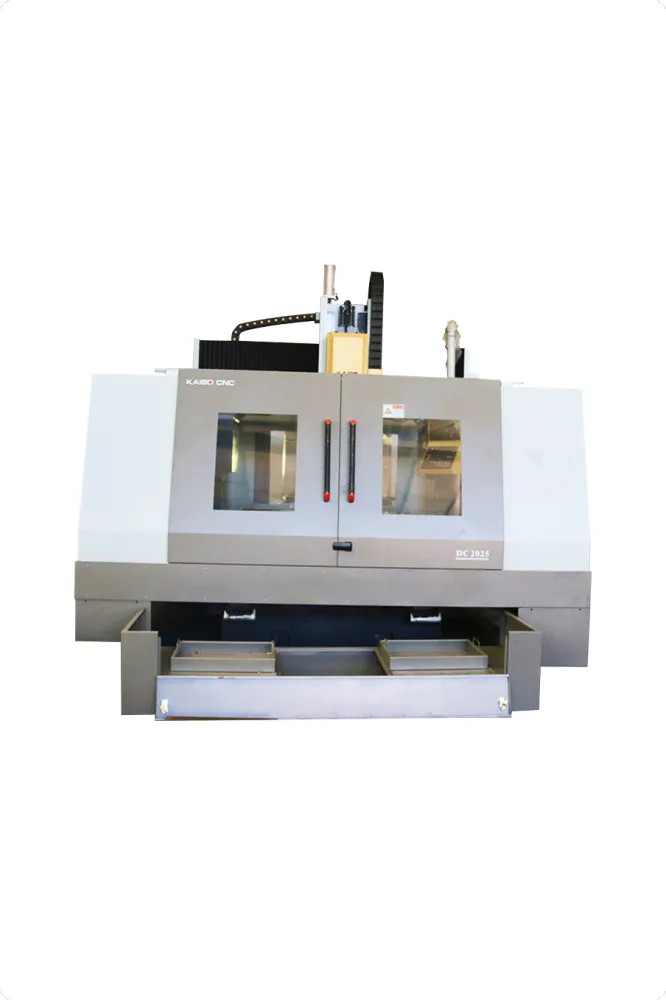
The DC1317 Dual-Column CNC Milling Center by Ningbo Kaibo embodies advanced geometric compensation, combining structural robustness with intelligent error correction. Its dual-column design provides unmatched stiffness (> 150% compared to single-column), reducing deformation under heavy cutting loads. The integrated compensation system continuously recalibrates axis positioning based on live feedback, ensuring repeatable accuracy throughout prolonged production runs.
| Parameter | DC1317 Dual-Column | Conventional Single-Column |
|---|---|---|
| Machine Stiffness (N/mm) | > 2,500,000 | ~1,600,000 |
| Positioning Accuracy (μm) | ±3 | ±8 |
| Thermal Drift (μm/hr) | < 2 | > 5 |
| Repeatability (%) | > 99.9 | ~97.5 |
In practical applications, automotive mold manufacturers report a 25-35% increase in first-pass yield rates using the DC1317 equipped with smart calibration versus traditional setups. This improvement translates directly to reduced rework, shortened lead times, and cost savings.
Adherence to ISO 230-1 and ASME B5.54 standards ensures that machine tool performance verification aligns with global benchmarks. Advanced coordinate measuring machines (CMM) and laser trackers validate part geometries post-machining, providing critical feedback to refine compensation algorithms. Integrating these technologies creates a closed-loop quality assurance system pivotal for automotive Tier 1 and Tier 2 suppliers.
Q1: How does thermal deformation affect mold precision during long milling cycles?
A1: Thermal deformation causes gradual expansion of machine components and the workpiece, shifting tool positions up to 10 microns over extended runs. This shift leads to dimensional inaccuracies and surface finish issues if uncorrected.
Q2: Can the DC1317’s compensation system be retrofitted to existing machines?
A2: While the DC1317’s hardware-software integration is optimized for new deployments, Ningbo Kaibo offers customized retrofit kits for select machine models, subject to structural compatibility and control system openness.
Q3: What maintenance practices ensure sustained compensation accuracy?
A3: Regular calibration of probes and sensors, environmental temperature control, and timely replacement of wear components preserve compensation fidelity and axis performance.


 <#else>





