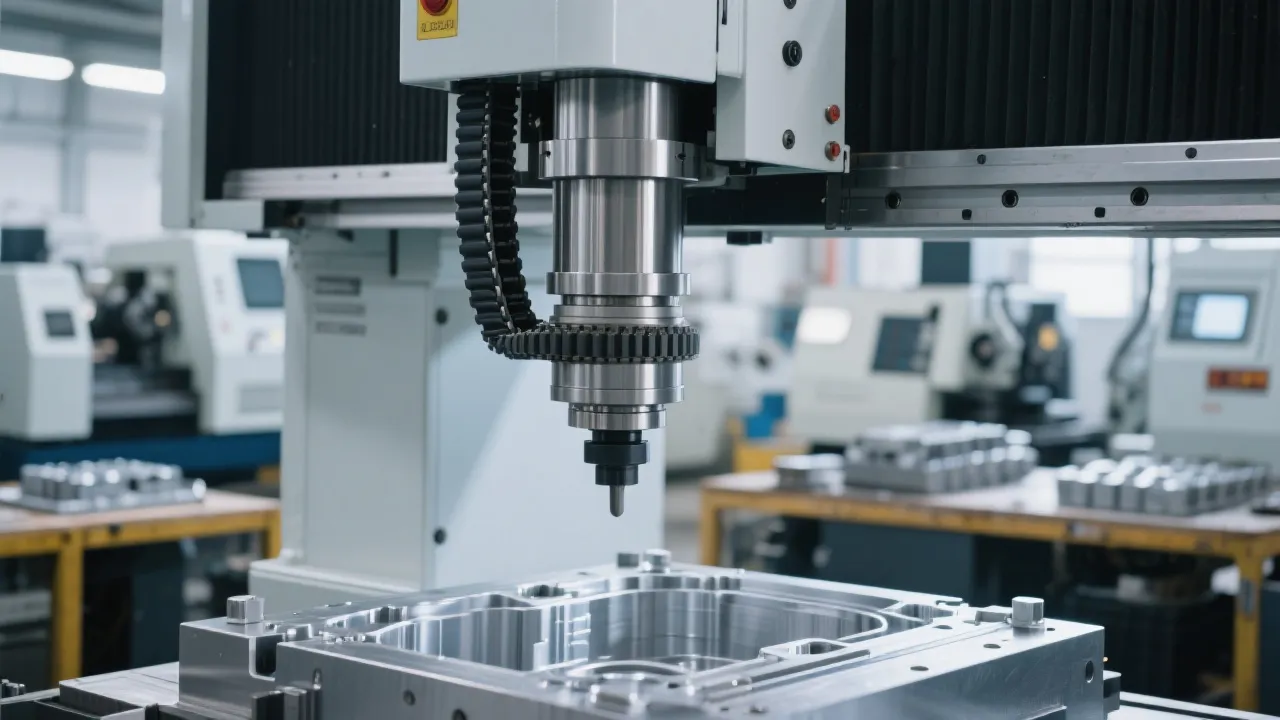
Selecting the right vertical machining center (VMC) is a critical decision that directly impacts your manufacturing efficiency, product quality, and return on investment. With over 30 years of expertise in CNC machinery manufacturing, Ningbo Kaibo CNC Machinery Co., Ltd. presents this comprehensive guide to help you navigate the selection process—from analyzing workpiece characteristics to determining the optimal axis configuration for your specific production needs.
Before evaluating machine specifications, a thorough analysis of your workpiece characteristics establishes the foundation for informed decision-making:
| Axis Configuration | Ideal Application Scenarios | Key Advantages | Typical Limitations |
|---|---|---|---|
| 3-Axis VMC |
• Simple 2D/3D parts with features on three primary faces • Single-setup machining of flat surfaces and holes • High-volume production of less complex components |
• Lower initial investment and operating costs • Simpler programming and setup • Higher rigidity for heavy cutting operations • Faster cycle times for appropriate applications |
• Requires multiple setups for complex geometries • Cannot machine undercuts or multi-angle features • Increased fixturing requirements for complex parts |
| 4-Axis VMC |
• Parts requiring indexing around a single axis • Cylindrical components with radial features • Parts with multiple faces that can be accessed via rotation |
• Reduces multiple setups to single setup machining • Improves positional accuracy between features • More versatile than 3-axis while maintaining good rigidity • Cost-effective upgrade from 3-axis capabilities |
• Limited to rotational indexing (not simultaneous motion) • Cannot access features requiring compound angles • More complex programming than 3-axis systems |
| 5-Axis VMC |
• Complex parts with multi-angle surfaces and undercuts • Aerospace, medical, and mold components • High-precision parts requiring simultaneous contouring • Workpieces with complex curved surfaces |
• Complete part machining in single setup • Improved surface finish through continuous tool orientation • Reduced fixturing costs and setup time • Ability to machine complex geometries efficiently |
• Higher initial investment and operating costs • Requires advanced programming skills • More complex maintenance requirements • May have reduced rigidity compared to 3-axis for heavy cuts |
"The most expensive machining center is not the one with the highest price tag, but the one that fails to meet your production requirements or operates below its optimal capacity." — Ningbo Kaibo CNC Technical Advisory Team
As a national standard setter for CNC engraving and milling machines with over 26 sales and service offices worldwide, Ningbo Kaibo CNC offers a comprehensive range of vertical machining centers designed to meet diverse manufacturing needs:
Our technical consultants work closely with manufacturing enterprises to analyze production requirements, recommend optimal configurations, and develop customized solutions that maximize productivity and return on investment. With Kaibo CNC's commitment to quality, innovation, and comprehensive after-sales support, you gain not just a machine, but a long-term manufacturing partner.